

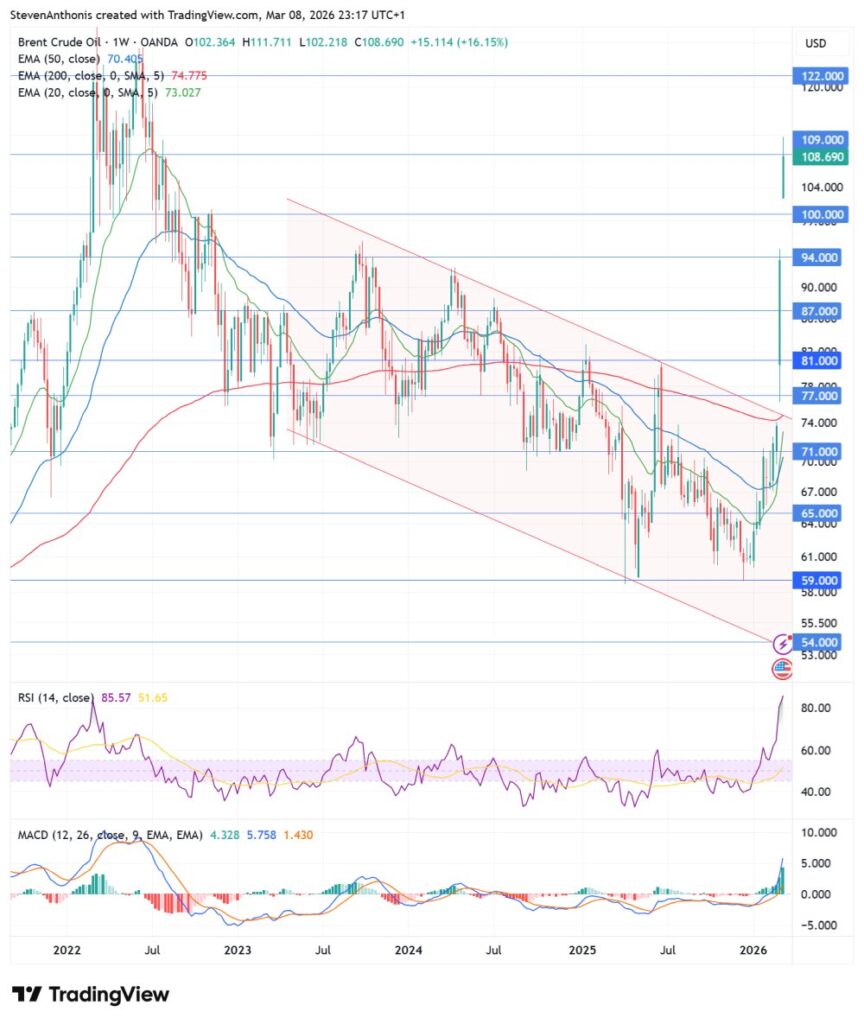
Rising geopolitical tensions in the Middle East have pushed oil prices sharply higher, with Brent crude climbing back above $100 per barrel. The conflict involving Iran, Israel, and the United States has raised fears of supply disruptions in one of the world’s most critical energy corridors.
At the same time, technical indicators on the weekly chart show a strong bullish breakout. While the rally could continue if tensions escalate, markets remain vulnerable to sudden reversals if the geopolitical situation stabilizes.
Middle East Conflict Sends Oil Prices Soaring
Oil prices surged over the past week after military strikes involving Israel, the United States, and Iran dramatically increased geopolitical tensions in the Middle East. Whenever conflicts emerge in regions that are critical for global energy supply, financial markets tend to react quickly. Oil traders in particular move fast to price in potential disruptions.
The Middle East remains the most important oil-producing region in the world. Any instability in the area can have far-reaching consequences for global energy markets, industrial production, and inflation.
The latest escalation has brought a key strategic chokepoint back into focus: the Strait of Hormuz.
The Strait of Hormuz: A Critical Energy Lifeline
Roughly 20% of the world’s seaborne oil trade passes through the Strait of Hormuz, a narrow waterway located between Iran and the United Arab Emirates. It connects the Persian Gulf with the Gulf of Oman and the wider global shipping routes.
Because of its strategic importance, the strait has long been considered one of the most sensitive points in global energy supply chains.
Iran has repeatedly warned that it could block the strait or target ships passing through it in response to Western military pressure. Even the mere threat of such actions is enough to drive oil prices higher, as shipping companies and energy traders begin to factor in the risk of disruption.
If tankers are forced to avoid the area, they must take much longer alternative routes, increasing both transportation time and costs. This immediately reduces the efficiency of global oil supply.
Some Countries Are Already Feeling the Impact
Several countries have already warned that the situation could severely disrupt energy markets.
Officials in Qatar have suggested that oil prices could surge to $150 per barrel within three weeks if the Strait of Hormuz remains blocked or unsafe for shipping.
Meanwhile, Kuwait has reportedly had to slow or temporarily halt production, as tankers are unable to collect oil shipments quickly enough due to the security concerns in the region. Limited storage capacity means producers cannot simply keep pumping without a functioning export route.
The situation is particularly challenging for China, the world’s largest oil importer. More than 50% of China’s oil imports pass through the Strait of Hormuz. If those flows are disrupted, Chinese companies must urgently seek alternative suppliers.
To secure new shipments, Chinese buyers may be willing to pay significantly higher prices, which would further push global oil prices upward.
Risk of Further Escalation
Iran has also warned that it could target oil infrastructure in neighboring countries in retaliation for attacks on its own energy facilities.
Energy installations such as pipelines, refineries, and export terminals are highly vulnerable during conflicts. Even limited damage can significantly reduce production capacity and tighten global supply.
Iranian officials have even suggested that oil prices could climb toward $200 per barrel if the conflict spreads and energy infrastructure across the region becomes a target.
While such extreme scenarios remain uncertain, markets clearly view the risk as serious enough to justify a sharp rise in oil prices.
Technical Analysis: Oil Breaks Out of Downtrend
Beyond the geopolitical story, the technical picture of the oil market has also turned bullish.
Looking at the weekly chart of Brent crude, the price has recently broken out above a long-term downward trend channel that had been in place for an extended period. This breakout suggests that the prolonged phase of price weakness has come to an end.
A series of moving average signals also supports this shift.
Earlier this year, oil prices climbed above the 20-week moving average, followed shortly after by a move above the 50-week moving average. These two averages have now formed a golden cross, a classic technical signal that often marks the beginning of a stronger upward trend.
More recently, oil prices have surged above the 200-week moving average, which is widely considered one of the most important long-term indicators in technical analysis.
If the market experiences a pullback, this 200-week moving average could now act as an important support level.
Momentum indicators confirm the strength of the move. The Relative Strength Index (RSI) has risen sharply, showing strong buying pressure. Meanwhile, the MACD indicator has turned positive, suggesting that upward momentum is accelerating.
Bullish Scenario: Supply Shock Drives Oil Higher
In a bullish scenario, geopolitical tensions continue to escalate or remain unresolved for an extended period.
If shipping through the Strait of Hormuz remains disrupted, global oil supply could tighten rapidly. With demand still relatively strong, this could push prices significantly higher.
Technically, the recent breakout from the downward trend channel opens the door for further gains. If the market maintains its momentum, oil prices could move toward the next major resistance levels around $122 per barrel.
A sustained supply shock could even push prices toward the levels mentioned by regional officials, particularly if energy infrastructure becomes directly involved in the conflict.
Bearish Scenario: Geopolitical Risk Fades
On the other hand, oil markets have historically reacted quickly to geopolitical events but can also correct rapidly once tensions begin to ease.
If diplomatic negotiations reduce the risk of supply disruptions and shipping routes remain open, some of the recent price spike could unwind.
From a technical perspective, oil prices are currently very overbought in the short term, as reflected by the high RSI reading. This increases the likelihood of a temporary correction after such a sharp rally.
In that case, oil prices could pull back toward the 200-week moving average or the $77–$81 range, which previously acted as an important resistance area and could now become support.
A Market Driven by Both Politics and Technicals
Oil markets are unique because they are influenced by both fundamental supply-demand dynamics and geopolitical risks. Political developments in the Middle East can rapidly shift the balance between supply and demand.
At the same time, the recent breakout on the weekly chart suggests that the oil market was already building upward momentum before the latest conflict.
If geopolitical tensions remain elevated, the technical breakout could fuel an even stronger rally. But if tensions ease, the market may quickly shift its focus back to global economic growth, production levels, and long-term energy demand.
For now, oil traders are watching both the geopolitical headlines and the key technical levels very closely.

