


Oil prices remain under significant pressure as rising supply, weak technical signals, and a fragile demand outlook weigh on the market.
While analysts warn that prices could drift toward $50 per barrel in the coming year, technical indicators suggest the market may be approaching an important decision point. The balance between oversupply fears and potential geopolitical shifts will determine whether oil finds a durable bottom or continues its downward trend.
Oversupply Keeps Oil Market Weak
According to several leading analysts, crude oil prices could continue to slide in the coming months, potentially falling toward the $50 per barrel level. The main driver behind this bearish outlook is the decision by OPEC+ to increase production, adding further supply to an already well-balanced or even oversupplied global market.
Analysts at SBI Research recently stated that oil prices are likely to remain relatively weak throughout the year as additional barrels come onto the market. They expect prices to approach $50 per barrel or lower by mid-year, reflecting persistent downward pressure from rising supply and muted demand growth.
Other major financial institutions share this view. Goldman Sachs forecasts an average oil price of around $53 per barrel in 2026. According to the bank, the global oil market could face an average surplus of roughly 2 million barrels per day this year. Such a surplus significantly reduces the likelihood of sustained price rallies, especially in the absence of strong geopolitical disruptions or unexpected demand shocks.
The U.S. Energy Information Administration (EIA) echoes this cautious outlook. The agency expects oil prices to average approximately $55 per barrel in the first quarter of 2026 and believes prices are likely to hover around that level for most of the year. This consensus among analysts reinforces the idea that supply-side factors currently outweigh bullish narratives.
Venezuela: A Long-Term Supply Wildcard
Another factor frequently mentioned in discussions about oil supply is Venezuela. The country is widely regarded as having the largest proven oil reserves in the world, estimated at nearly 20% of global reserves. Despite this enormous resource base, Venezuela currently accounts for only about 1% of global oil production.
Years of communist economic policies, mismanagement, underinvestment, and international sanctions have severely weakened the state oil company PDVSA. As a result, Venezuela’s production infrastructure has deteriorated significantly.
Although recent political developments, with the capturing of President Nicolás Maduro, have attracted attention, they have not yet had a meaningful impact on oil prices. This is because any meaningful increase in Venezuelan production would take years to materialize.
Venezuelan crude is heavy and sulfur-rich, requiring specialized refining capacity. Companies such as ExxonMobil, Chevron, and ConocoPhillips invested heavily in this infrastructure in the past. However, in 2007, former president Hugo Chávez nationalized the oil industry and expropriated foreign assets, creating long-lasting tensions with the United States.
While U.S. policymakers may be interested in restoring Venezuelan oil production under American corporate control, significant investment would be required. Analysts estimate that rebuilding Venezuela’s oil infrastructure could take at least a decade and require annual investments of around $10 billion. This suggests that Venezuela is unlikely to flood the market with additional barrels in the near future.
Technical Analysis: A Market in a Clear Downtrend
Turning to the weekly Brent crude oil chart, the technical picture confirms the fundamental weakness. Prices remain in a well-defined downward trend channel, characterized by lower highs and lower lows. This structure has been intact for an extended period, underscoring the persistent bearish momentum.
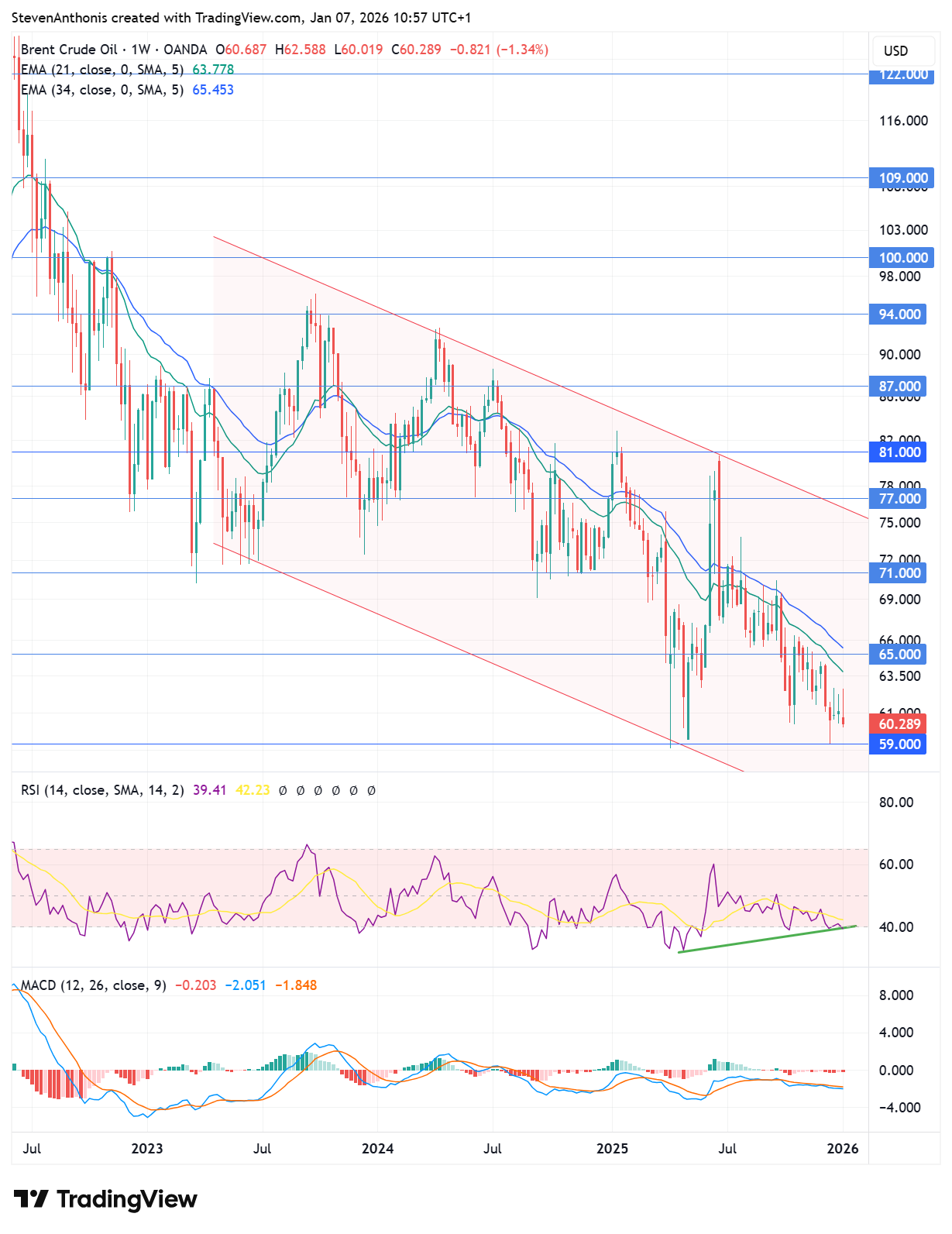
The price recently tested the $59 level, which acted as support in the past. Whether this level can hold again is a key question. A sustained break below $59 would likely open the door to further downside, potentially accelerating the move toward the $50–55 zone highlighted by analysts.
Momentum indicators paint a mixed but still cautious picture. The Relative Strength Index (RSI) is hovering below the 40 level, indicating weak momentum. However, a mild bullish divergence is forming, as RSI has started to trend slightly higher while price remains near recent lows. This divergence often serves as an early warning sign that downside momentum is weakening, though it does not guarantee an immediate reversal.
The MACD remains below the zero line, confirming that the broader trend is still bearish. Moving averages are also sloping downward, and price remains below key exponential averages, reinforcing the notion that sellers remain in control.
Bullish and Bearish Scenarios
Bearish scenario:
If oil prices fail to hold above the $59 support level, the downtrend is likely to continue. A decisive weekly close below this area would strengthen the bearish case and increase the probability of a move toward $55 or even $50 per barrel. In this scenario, oversupply concerns and weak technical momentum would remain dominant, and any rallies would likely be corrective rather than trend-changing.
Bullish scenario:
For the bearish outlook to weaken, oil prices would need to reclaim key technical levels. A sustained move above $65 would be an important first signal that selling pressure is easing. Such a move would also bring prices back above short-term moving averages, potentially shifting market sentiment. If accompanied by improving momentum indicators and supportive macro or geopolitical developments, this could mark the early stages of a broader recovery.
Conclusion
Oil markets are currently caught between strong supply-side headwinds and tentative signs of technical stabilization. While the dominant trend remains bearish, and many analysts expect lower prices in the coming year, early warning signals suggest that the pace of the decline may be slowing. Whether oil ultimately finds a durable bottom or continues its descent will depend on how supply dynamics, geopolitical developments, and technical levels evolve in the months ahead.

